A fascinating piece in the Guardian today about an FAO policy paper on the eating of insects. Apparently, senior figures in the UN and elsewhere are looking for ways to boost consumption of creepy-crawlies as a means of reducing greenhouse gas emissions. Rearing livestock such as cows, pigs and sheep guzzles agricultural land and spews out 20% of global greenhouse gases, and so we all need to start eating less meat. Insects, it seems, are a promising alternative, since they are rich in protein, vitamins and minerals, and breeding them produces far less pollution than breeding conventional meat animals. The only problem, according to the experts cited in the article, is the Western taboo on eating insects.
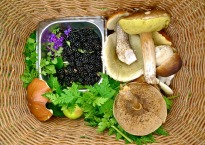
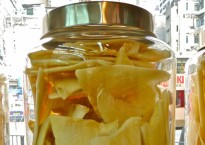
If you are interested in this subject, I heartily recommend this extraordinary book by the Victorian Englishman Vincent Holt, which deploys powerful, rational arguments in favour of eating insects – and offers some recipes that sounds rather interesting. It’s a delightful, amusing and provocative little book. You might also like to read my thoughts on the subject in a piece for the FT a few years ago, which is on this website. The photographs that accompany this post are of some of the ingredients (raw and cooked) on the menu of Zou Haikuan’s restaurant, which is mentioned in my article.
Continue reading…
Tags: insects

A delicious tangle of octopi!
I was just looking through one of my notebooks, and found a rather endearing story. It was in Ningbo, at the end of a fabulous dinner that had involved, among other things, divine little octopi (served whole), crunchy jellyfish, salted raw crab, white shrimps and red-braised pork with sea moss, and the chef was telling us all about a culinary conference he’d attended in a nearby city. ‘You know, everyone at the conference agreed [he sighed as he said this] that Western science was very advanced and developed, but that Western food didn’t amount to much. Whereas China might not have such advanced science, but the Chinese had really moved their brains 动了脑筋 when it came to food.’
It’s not the first time I’ve heard Chinese people blaming gastronomy for their country’s decline in the nineteenth and twentieth centuries*, but I loved the way he expressed it!
*In my ‘Shark’s Fin’ book I think I mentioned the Xi’an taxi driver who picked me up from the Banpo Neolithic village, and who moaned on the way back into town about the fact that the Chinese had invented steaming in the Stone Age, but had only applied it to cooking, leaving it to the British, many centuries later, to invent the steam engine.
Tags: Ningbo

A geng
It’s funny how the UK’s weird and inconclusive general election result has brought out the food metaphors! The Mayor of London, Boris Johnson, spoke of a future coalition government as a sausage, in which the meat should be Conservative. And the BBC’s political reporter said on the radio at lunchtime that any government proposed by our current prime minister, Gordon Brown, would be a difficult cake to mix, because it would have to involve too many ingredients!
It reminded me of that age-old Chinese metaphor for the juggling of rival political interests: the seasoning of a stew (or, to be precise, a geng 羹, which is a kind of soup that is thick with cut ingredients – as opposed to a tang 汤, which is a lighter, more soupy type of soup). As David Knechtges says in a fascinating essay on this*: ‘In the Chinese classics, the proper seasoning of food is a common analogy for good government… The comparison of the perfectly blended stew with the art of good government is a commonplace both in ancient and later literature.’ Continue reading…
Posted by Fuchsia
on May 01, 2010
Unusual delicacies /
8 Comments
When your dinner guests include a scientist who makes ice cream with liquid nitrogen at his own parties, and a food writer and broadcaster who is notorious for his adventurousness, how do you surprise and entertain them? I decided it was time to cook the dried frog ovaries I bought in Hangzhou last year.
Known in Chinese as 雪蛤 (xueha), and in English as hasma, hashima, snow frog etc (see this article by Jacqueline Newman in Flavour and Fortune), it’s one of those Chinese delicacies that is baffling to Westerners. It’s usually described as frog fallopian tubes, ovarian fat or ovaries – I’m not sure exactly what is is, but it’s the waxy looking amber-coloured stuff that encloses the eggs of dried snow frogs from the northeast of China. After a long soaking, and steaming, small pieces of this substance expand miraculously into flubberous, transparent clouds of tasteless texture. They are often served with papaya, or in soups that may be slightly sweetened. Continue reading…
Tags: frog ovaries, xueha
Posted by Fuchsia
on March 02, 2010
Unusual delicacies /
2 Comments
I’ve been discussing camel cookery with my friend Anissa Helou, an expert on Middle Eastern food, and Charles Perry, an expert on Medieval Arabic food, on Anissa’s blog. I would love to post a picture of a dead camel here, but unfortunately it’s from my pre-digital period and I don’t have a scanner!
Tags: camel
Posted by Fuchsia
on February 10, 2010
Cooking,
Unusual delicacies /
No Comments
One thing I never thought I’d be is an agony aunt for people struggling to cook ox penises!
According to reports in various newspapers (such as the Guardian in the UK), legal experts in China are proposing that a new law to prevent the abuse of animals should include a ban on the consumption of cats and dogs. As anyone who lives in China knows, eating these animals is rather unusual, and generally limited to a few regions. Moreover, eating dog meat, though it dates back to ancient times, is a seasonal delicacy, suitable only for very cold weather because of its heating qualities. Looking at Western discussions of Chinese food, however, you’d never know that it was a minority pursuit. Westerners, as I argued in this op-ed piece in the New York Times a couple of years ago, have been obsessed with Chinese dog-eating since the time of Marco Polo. It’s something they just love to get outraged about. Continue reading…
Tags: dog meat
You can hear me talking about eating shark’s fin (or not) on the BBC today (or read the piece here).
While I was writing it, I came across a page I tore out of the South China Morning Post in October last year. It includes a letter from Dr Choo-hoo Giam, a member of the animals committee of CITES, the Convention on International Trade in Endangered Species. What is particularly interesting about the letter is that Dr Giam points out the extent to which it is not only the Chinese and their notorious shark’s fin soup that are to blame for the devastation of worldwide shark stocks. The main points Dr Giam makes are as follows: Continue reading…
Tags: Shark's Fin
Posted by Fuchsia
on December 28, 2009
Environment,
Unusual delicacies /
10 Comments

Slow-cooked bear paw with duck wings - image from an old Chinese cookery book
The Chinese penchant for eating endangered species is in the news again. Today the BBC ran a report by Moscow correspondent Rupert Wingfield-Hayes about the poaching of Asiatic black bears in northeastern Russia. The culprits? Suppliers of bear’s paws and gall bladders to China, where the paws are an ancient delicacy, and the gall is prized for its medicinal properties. And last week, the official Chinese news agency Xinhua reported that a man in Yunnan Province had been jailed for 12 years for killing, and then eating, a rare and endangered Indochinese tiger (in this case, the man at least claimed that it had been shot accidentally, after dark.)
Bear’s paw is one rare Chinese delicacy that I have never been offered, thank goodness. If in the future I do see one on a dinner table, rest assured that I will restrain my curiosity and refuse it. And yet I can’t help wondering if eating such things, gross and unconscionable though it may be, is any worse than driving a car, travelling by plane, using consumer goods whose manufacture and disposal causes catastrophic pollution, or eating a lot of factory-farmed meat. It’s much easier to make a moral point by refusing bear’s paw (particularly if it’s not part of your own culture) than it is to address seriously the impact of our consumerist lifestyles on the planet and its biodiversity, isn’t it?
Tags: bear's paw

Camellia oil, hot off the press
There’s an article of mine in the Financial Times Weekend today, about the dilemmas facing China’s artisanal food producers.
The picture on the right was taken at the camellia oil press described in the article, just after I’d tasted the oil.
Tags: Slow Food