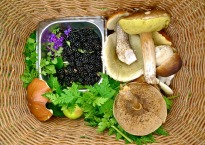
The range of fresh Chinese vegetables available in London is growing all the time, and the best news is that some of them are grown locally. Among the home grown greens I’ve found recently is this Malabar spinach. It’s a favourite vegetable in Sichuan, where it is often served in clear soups or stir-fried with garlic. Its plump, rounded leaves have a
delightfully slippery texture after cooking, which is why it is known as ‘cloud ear mushroom vegetable’ (mu’er cai 木耳菜) or ‘tofu vegetable’ (dou fu cai 豆腐菜 )The flavour of the leaves is reminiscent of spinach.
Sichuanese cuisine
Chinese food culture, Cooking, Festivals, Sichuanese cuisine / 12 Comments
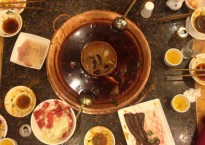
Last year I gave you a few photographs of Chinese New Year in Hunan, 2004. This year, here are a couple of photographs of Chinese New Year meals in the far north of the country, in a remote part of Gansu Province in 1995. They were taken in the village that is the subject of the chapter ‘Hungry Ghosts’ in my book Shark’s Fin and Sichuan Pepper. (Please forgive the poor quality of the images! I may try to scan them properly another time!)
On the right, you can see a pair of fish (fish are an almost obligatory part of New Year’s Eve dinners because nian nian you yu is a phrase that can mean both ‘fish every year’ and ‘plenty every year’: so the dish is an auspicious play on words.) Continue reading…
In the last month of the lunar year, the Sichuanese often cure their own meats: spicy wind-dried sausages, smoked bacon and marinated, wind-dried pork (酱肉)。I was hoping to make some sausages this year, but didn’t have time, so I made instead some jiang rou 酱肉。 It is pork leg that is salted for a few days, wind-dried, marinated in sweet fermented sauce (甜面酱),rice wine, sugar and spices, and then wind-dried once again. You can see some in the photograph on the left, hanging outside my kitchen window. The weather is perfect now: cold but not freezing, rather like in Sichuan. Tomorrow night I will rinse some of the meat, steam it, slice it and then serve it as part of my New Year’s Eve dinner.
Afterwards:
I wanted to show you a couple of uses for this home-cured meat. On the right you can see how I served it on New Year’s Eve: simply rinsed, steamed, cooled, sliced and served with a dip of ground chillies (you can add a little ground roasted Sichuan pepper too, if you like). The meat has an intense umami flavour, a little like ham.

Another scrumptious use for it is to chop it finely and use it to add an umami deliciousness to fried rice or eight-treasure stuffings. Below you can see the fried rice I made with leftovers from the dinner: a little home-cured pork; an egg or two, beaten; finely chopped gai lan (Chinese broccoli); a little ginger and garlic; and a whisper of sesame oil to finish.
Anissa Helou beat me to it with her blog post about today’s culinary collaboration! Anyway, here’s mine. Anissa (a brilliant cook and food writer specialising in Middle Eastern culinary cultures) and I had been planning a joint Sino-Lebanese lunch for months, and we finally did it, sort of, because in the end it turned out to be Sino-Moroccan. I was in charge of the first course, Anissa of the main course and dessert. As I was cooking at home and planning a ‘Chinese takeaway’ delivery to Anissa’s place, it seemed like a good opportunity to use one of my Sichuanese cuan he ( 攒盒), the gorgeous lacquered boxes that are sometimes used for banquet appetisers. Each box comes with an ornamented lid – in this case a dragon and phoenix (see below), and a neat jigsaw of detachable compartments for the food. The smallest boxes have one central compartment with four others around: this is known as a ‘five-colour’ box. The one I used today is a ‘nine-colour’ box, although I cheated slightly because I only made eight dishes (as you can see, one is duplicated in two compartments). Continue reading…
Look at this beauty! It’s a tiny Sichuan pepper tree! It was a present from Richard S., a friend of the Oxford Food Symposium’s, who managed to track one down in a specialist nursery in the UK. He told me he’d give me one a long time ago, and here it is! The leaves have some of that bewitching pepper fragrance if you squeeze them between your fingers. I have no idea how long it will take to bear fruit, but I hope it will eventually – I have seen one fruitful Sichuan pepper tree growing in Oxford, so I know it’s possible in the English climate! At the moment it’s sitting in a pot on my sunny, south-facing windowsill, but I hope to transplant it to my parents’ garden in Oxford before too long, where it will have more room to grow.
As those of you who have read my ‘Shark’s Fin and Sichuan Pepper’ may know, I have never quite got over abandoning a tiny Sichuan pepper tree from Hanyuan at Beijing airport a few years ago. I had transported it very tenderly all the way from the mountains of Hanyuan to Beijing, but Britain was in the midst of the foot and mouth epidemic, with widespread paranoia and tight restrictions on agricultural imports, and I chickened out at the last moment and left it behind.
Of course, you can get a club sandwich from room service at any international hotel in China, and probably anywhere in the world, but how about this room service menu from a hotel I stayed in in Chengdu? It was wonderfully reassuring to know that I could summon up some diced rabbit in chilli oil or dan dan noodles if the need arose. The only problem was that when the need did arise with the onset of late-night munchies, the kitchen had closed for the evening. It was then that I noticed that the room service was only available until 9pm.
Fortunately, I was able to sneak out
of the hotel, where I passed a mobile 烧烤 stall where a man was grilling everything you could think of on bamboo sticks, and then found a whole row of little eateries selling dishes made with goat, a speciality of Jianyang (简阳), a town to the southeast of Chengdu.
The extensive menu at the place I chose included every part of the goat you can think of, made into cold dishes, hot dishes, snacks and nourishing soups. Some of the dishes were versions of mainstream classics such as twice-cooked pork and red-braised pork, but made with goat. Since I was on my own and had eaten a rather large dinner a few hours Continue reading…
Yes, many of you guessed correctly, the dagger is a fishbone! To be precise, it’s a bone from the head of the Ya fish (雅鱼, a type of carp also known as 丙穴鱼), which is a speciality of the western Sichuanese town of Ya’an. (you can see a picture of the fish here). The fish, which is often made into a claypot stew, is famously tender, with few bones and delicious savoury flesh.
On the left, you can see a Ya fish, presented dramatically in a cloud of dry ice in its raw state, to be cooked in the dining room, in the pot on the left-hand side of the photograph.
My hosts that night mentioned some colourful legends about the knife in the fish’s head, and I’ve done a little research today. There seem to be a few different versions of the story. Some say that the bone was formed when the creator goddess Nu Wa 女娲,while patching up holes in the sky, let her double-edged sword fall into the waters of the river at Ya’an, far below. One tells of an evil river demon who demanded that a beautiful girl be given to him as a bride, threatening calamitous floods if the people of Ya’an failed to oblige him. A young woman volunteered to save her community by offering herself up as his wife, and she challenged the demon with a double-edged sword. All the fish in the river, so the legend goes, decided to commemorate the bravery of her sacrifice, by forming an image of the sword in their heads, and using it to suppress the river fiend.
My first book, Sichuan Cookery (published in the US as Land of Plenty), was chosen by the Observer Food Monthly as one of the ten best cookbooks of all time! Crazy, but delightful!
My acupuncturist friend Simon came for lunch the other day, and one of the dishes I cooked was that old favourite mapo doufu (Pock-Marked Old Woman’s beancurd). For some reason we ended up talking about Sichuan pepper, and Simon mentioned that he had some stocks in his pharmacy. I doubted that it would be as zingy as the best stuff, so I sent him home with a sample of the pepper I use (a gift from my chef friend Yu Bo), with strict instructions to try his regular pepper first, and then try chewing a bit of mine. His comments, copied below with his permission from an email he sent me yesterday, are a good illustration of what it’s like trying fantastic Sichuan pepper for the first time!