•
5 Min Read
•
5 Min Read
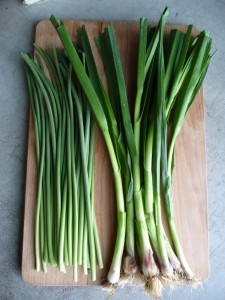
One Chinese vegetable that I always miss when I'm in London is green garlic, which the Sichuanese call suan miao 蒜苗 and people in other parts of China call qing suan é’è’œ. These leafy, pungent alliums are the most common vegetable accompaniment to twice-cooked pork 回锅肉, and are also traditionally added to mapo tofu 麻婆豆è…. In Hunan, they are often used in simple stir-fries, perhaps with some of the glorious local smoked pork 腊肉. It's rare to find them in England, so imagine my delight to find them on sale just before the Chinese New Year! You can see them on the righthand side of the chopping board in the picture on the left. As you will notice, they look very similar to Chinese green onions (a.k.a. scallions, spring onions), but they have flat leaves, like leeks, and a hint of purple around their bulbs. In my Sichuan cookery book I recommended using baby leeks for twice-cooked pork and spring onions for mapo tofu because green garlic is so rarely available, but if you can find it, snap it up and use it instead! (it takes rather less time to cook than baby leeks, and marginally longer than spring onions).
On the lefthand side of the board are garlic stems (known confusingly as suan tai 蒜薹 in Sichuan, suan miao 蒜苗 in Hunan and suan xin 蒜芯 in at least some Cantonese areas. In China, they are often sold complete with their little bulbs on the top of each stem; here in England, where they can be found in some Chinese greengrocers, they are usually trimmed and bulbless. Raw, they have a strong and forthright pungency, but when you stir-fry them they become sweet and mellow. They are heavenly stir-fried with cured meats or firm pressed tofu.
One Chinese vegetable that I always miss when I'm in London is green garlic, which the Sichuanese call suan miao 蒜苗 and people in other parts of China call qing suan é’è’œ. These leafy, pungent alliums are the most common vegetable accompaniment to twice-cooked pork 回锅肉, and are also traditionally added to mapo tofu 麻婆豆è…. In Hunan, they are often used in simple stir-fries, perhaps with some of the glorious local smoked pork 腊肉. It's rare to find them in England, so imagine my delight to find them on sale just before the Chinese New Year! You can see them on the righthand side of the chopping board in the picture on the left. As you will notice, they look very similar to Chinese green onions (a.k.a. scallions, spring onions), but they have flat leaves, like leeks, and a hint of purple around their bulbs. In my Sichuan cookery book I recommended using baby leeks for twice-cooked pork and spring onions for mapo tofu because green garlic is so rarely available, but if you can find it, snap it up and use it instead! (it takes rather less time to cook than baby leeks, and marginally longer than spring onions).
On the lefthand side of the board are garlic stems (known confusingly as suan tai 蒜薹 in Sichuan, suan miao 蒜苗 in Hunan and suan xin 蒜芯 in at least some Cantonese areas. In China, they are often sold complete with their little bulbs on the top of each stem; here in England, where they can be found in some Chinese greengrocers, they are usually trimmed and bulbless. Raw, they have a strong and forthright pungency, but when you stir-fry them they become sweet and mellow. They are heavenly stir-fried with cured meats or firm pressed tofu.
Keep reading


