•
5 Min Read
•
5 Min Read
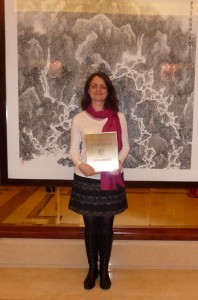
At the conference today I received a Hunanese government award for contributions to the internationalisation of Hunan cuisine! It was worth getting up at what seemed like ungodly hour, after a jetlagged and somewhat sleepless night. The hall was packed with about 300 delegates, and I was the only Westerner - a weird throwback to my early days in China. Awards in the international category were also given to my friend and colleague, Bashan/Barshu owner Shao Wei; Â Peng Tieh-cheng, son of Peng Chang-kuei; and Susur Lee. And there were also awards for local chefs and restaurants. Shao Wei and I spent the rest of the morning doing interviews with local media (I think we may be on TV tonight!), and then I had to give a brief talk after lunch. A bit nightmarish having to speak in Chinese before such a crowd, but it seemed to go OK, and I managed to entertain them with tales of persuading Westerners to love eating preserved duck eggs and rubbery things!
My afternoon ended peacefully with a visit to the Hunan Provincial Museum, to see once again the incredible [Mawangdui collection](http://en.wikipedia.org/wiki/Mawangdui). This is a large group of
[caption id="attachment_1466" align="alignright" width="300" caption="Ancient lacquerware from the Mawangdui trove"]

[/caption]
objects that was unearthed in three aristocratic tombs on the outskirts of Changsha in the 1970s: one of the richest archaeological sites in China. It is particularly interesting to me because the tombs, which date back to the Han Dynasty, about two thousand years ago, contained a treasure trove of foodstuffs and records (inscribed on bamboo slips) of the cooking of the time, along with beautiful red-and-black lacquerware, much of it used for storing and serving food. Apart from the food-related remains, there are models of singers, dancers, a make-up box, a chess set, models of musical instruments, and textiles in a remarkable state of preservation. If you're interested in this sort of thing, it's worth making a trip to Changsha just to see the museum.
At the conference today I received a Hunanese government award for contributions to the internationalisation of Hunan cuisine! It was worth getting up at what seemed like ungodly hour, after a jetlagged and somewhat sleepless night. The hall was packed with about 300 delegates, and I was the only Westerner - a weird throwback to my early days in China. Awards in the international category were also given to my friend and colleague, Bashan/Barshu owner Shao Wei; Â Peng Tieh-cheng, son of Peng Chang-kuei; and Susur Lee. And there were also awards for local chefs and restaurants. Shao Wei and I spent the rest of the morning doing interviews with local media (I think we may be on TV tonight!), and then I had to give a brief talk after lunch. A bit nightmarish having to speak in Chinese before such a crowd, but it seemed to go OK, and I managed to entertain them with tales of persuading Westerners to love eating preserved duck eggs and rubbery things!
My afternoon ended peacefully with a visit to the Hunan Provincial Museum, to see once again the incredible [Mawangdui collection](http://en.wikipedia.org/wiki/Mawangdui). This is a large group of
[caption id="attachment_1466" align="alignright" width="300" caption="Ancient lacquerware from the Mawangdui trove"]
[/caption]
objects that was unearthed in three aristocratic tombs on the outskirts of Changsha in the 1970s: one of the richest archaeological sites in China. It is particularly interesting to me because the tombs, which date back to the Han Dynasty, about two thousand years ago, contained a treasure trove of foodstuffs and records (inscribed on bamboo slips) of the cooking of the time, along with beautiful red-and-black lacquerware, much of it used for storing and serving food. Apart from the food-related remains, there are models of singers, dancers, a make-up box, a chess set, models of musical instruments, and textiles in a remarkable state of preservation. If you're interested in this sort of thing, it's worth making a trip to Changsha just to see the museum.
Keep reading


