•
5 Min Read
•
5 Min Read

I've always rather admired those incredible Chinese cold-cut platters 冷盘, in which auspicious scenes are recreated in a collage of little slices of food. Sometimes they may be assembled from slices of cooked tongue, roast duck and other meaty ingredients, sometimes from multicoloured vegetables, often a mixture of both. It's rare to see them in restaurants these days, because they require a great deal of patient work and artistry - in China, I think I've only seen them as exhibition pieces in culinary competitions. But I love to flick through cookery books that show some of these extraordinary platters in their full glory.
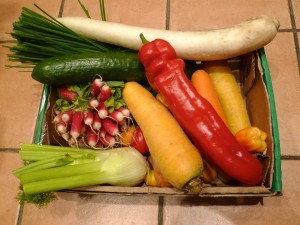
[caption id="attachment_2800" align="alignleft" width="180" caption="My palette of ingredients to play with"]
[/caption]
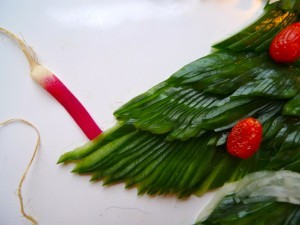
[caption id="attachment_2803" align="alignright" width="180" caption="Detail of pine needles"]
[/caption]
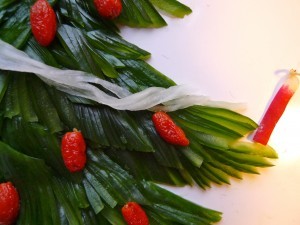
[caption id="attachment_2806" align="alignright" width="180" caption="Detail of tinsel"]
[/caption]
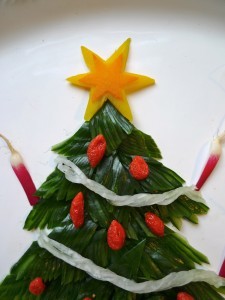
Anyway, I've never attempted anything of the sort before, but thought it would be fun to try to make an edible Christmas tree in homage to this Chinese tradition. And after several hours of painstaking work last weekend, here you are! The Christmas tree is made from pieces of cucumber skin sliced into little fans; the tree trunk and tub from soaked dried shiitake mushrooms, with a red ribbon made from a red pepper; the baubles are gouqi berries; the star is two slices of different-coloured carrots; and the tinsel from very fine shreds of white radish, twined together. My favourite detail is the candles, which are simply tiny pieces cut from little pink radishes, each of which came with its own little 'plume of smoke' in the form of the root!
[caption id="attachment_2809" align="alignleft" width="135" caption="Detail of star"]
[/caption]
I've always rather admired those incredible Chinese cold-cut platters 冷盘, in which auspicious scenes are recreated in a collage of little slices of food. Sometimes they may be assembled from slices of cooked tongue, roast duck and other meaty ingredients, sometimes from multicoloured vegetables, often a mixture of both. It's rare to see them in restaurants these days, because they require a great deal of patient work and artistry - in China, I think I've only seen them as exhibition pieces in culinary competitions. But I love to flick through cookery books that show some of these extraordinary platters in their full glory.
[caption id="attachment_2800" align="alignleft" width="180" caption="My palette of ingredients to play with"]
[/caption]
[caption id="attachment_2803" align="alignright" width="180" caption="Detail of pine needles"]
[/caption]
[caption id="attachment_2806" align="alignright" width="180" caption="Detail of tinsel"]
[/caption]
Anyway, I've never attempted anything of the sort before, but thought it would be fun to try to make an edible Christmas tree in homage to this Chinese tradition. And after several hours of painstaking work last weekend, here you are! The Christmas tree is made from pieces of cucumber skin sliced into little fans; the tree trunk and tub from soaked dried shiitake mushrooms, with a red ribbon made from a red pepper; the baubles are gouqi berries; the star is two slices of different-coloured carrots; and the tinsel from very fine shreds of white radish, twined together. My favourite detail is the candles, which are simply tiny pieces cut from little pink radishes, each of which came with its own little 'plume of smoke' in the form of the root!
[caption id="attachment_2809" align="alignleft" width="135" caption="Detail of star"]
[/caption]
Keep reading


